Short answer: no. RTP is one of those numbers that gets thrown around a lot in online casino lobbies, but it doesn't work the way most people assume the first time they see it. It's not a per-spin refund rate, and it's definitely not a promise about what happens to your next $10 bet. Here's what it actually is, and why that distinction matters more than the marketing copy suggests.
Return to Player is calculated across the full lifespan of a game's math model — millions of simulated rounds, not the twenty spins you're about to play on your lunch break. Play'n GO's Book of Dead carries a listed RTP of 96.21%. That number comes from testing labs like GLI or eCOGRA running the game's random number generator through an enormous sample size — the kind of volume no individual player will ever come close to in a lifetime, let alone a single session.
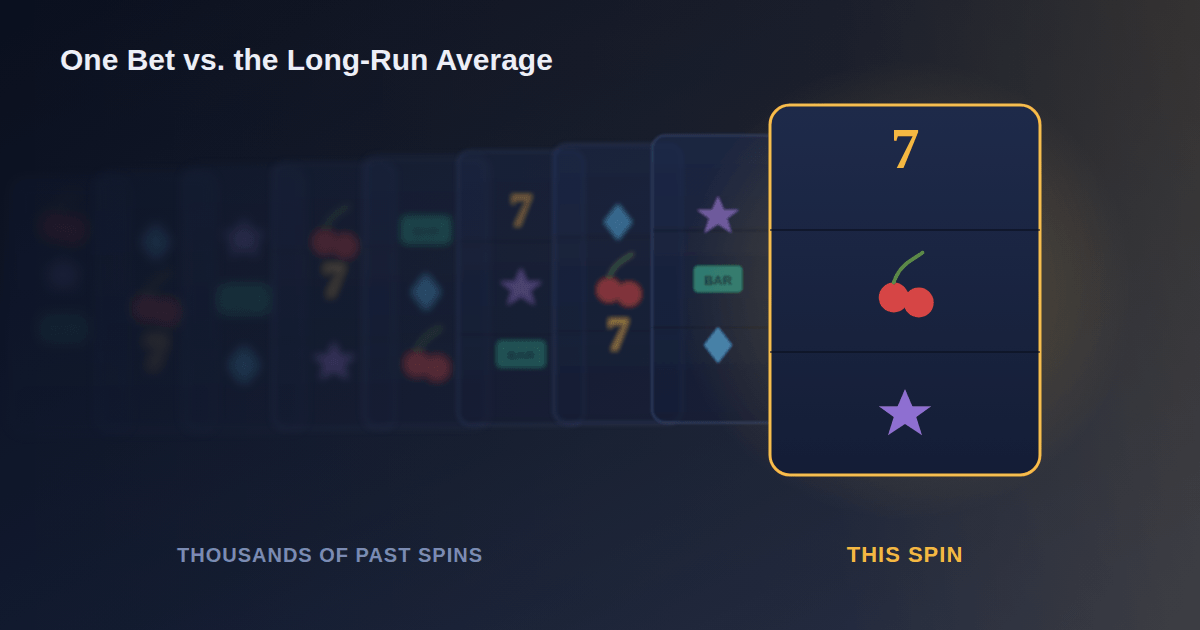
So when you sit down and place one bet, 96.21% isn't sitting there waiting to pay you back 96 cents on the dollar. Your one bet has exactly two outcomes: you win something, or you don't. The percentage only starts to mean anything once you zoom out to thousands of rounds — which is a very different picture from "the machine owes me a return."
This trips people up constantly, and it's a fair thing to be confused about. NetEnt's Starburst sits at 96.09% RTP, which is considered generous for a slot. Play it for twenty spins, and you can absolutely walk away empty-handed — the RTP hasn't failed you, it just hasn't had enough rounds to express itself yet. Flip a coin five times and there's a decent chance you get four heads and one tail. That doesn't mean the coin is broken. It means five flips isn't a big enough sample for the 50/50 to show up.
The same logic applies to a losing streak on a high-RTP slot, or a lucky run on a game with worse odds. Individual outcomes are governed by the random number generator, not by the RTP figure. RTP describes the shape of the results after a huge number of rounds — it says nothing about the order they arrive in or how any one session will go.
There's no single magic number, but it's a lot more than most players expect. Game studios typically simulate anywhere from 1 million to 100 million rounds when calculating and certifying a game's RTP. Your own play — even a heavy weekend session of a few thousand spins — is a rounding error against that. That's part of why two players can post wildly different results on the exact same slot in the exact same week without either of them experiencing a "rigged" game. Both are just small, noisy samples of the same long-run distribution.
RTP and house edge describe the same math from opposite directions. A game with 96% RTP has a 4% house edge — that 4% is the built-in margin the casino keeps over the long run, the same way a casino floor is built to be profitable regardless of who wins on any given Tuesday night. Table games tend to have noticeably lower house edges than slots when played correctly: blackjack under basic strategy can push RTP up toward 99.5%, and European roulette runs about 97.3% thanks to its single zero, versus roughly 94.7% for the double-zero American wheel. None of that changes the fact that on any individual hand or spin, the house edge is irrelevant — it's a long-run structural fact, not a live countdown.
RTP is genuinely useful — just not for the reason a lot of people think. It's not a predictor of your next session. It's a comparison tool. If you're choosing between two slots you'd otherwise enjoy equally, the one with 97% RTP will, over a large enough volume of play across all players, cost less than the one at 92%. That's a real, meaningful difference — it just plays out at the population level, not in your individual results this weekend.
A few things worth keeping in mind when you're comparing games:
So no, RTP doesn't apply to any single bet, and it was never designed to. It's a long-run average built from a sample size you'll never personally reach. Treat it as a way to compare games against each other, not as a forecast for tonight, and the number starts making a lot more sense.
Subscribe to our mailing list and get our exclusive deals straight to Your inbox!